
O.J. Lawal, P.A. Olubambi, D.E.P. Klenam, M.O. Bodunrin, and S.S. Lephuthing, “A review on low-density steels: Effect of processing techniques and parameters on microstructure and mechanical properties,” Manufacturing Review, vol. 13, no. 3, 2025031, 2026.
Research Thrusts & Publications
Publications from the research advance sustainable physical metallurgy through the design of impurity-tolerant dilute and complex concentrated alloys for structural and multifunctional applications. The work is anchored in a materials–methods–mechanisms nexus, integrating advanced characterisation, computational modelling and machine learning.
86+
Total Publications
72
Journal Articles
15
Book Chapters
3
M³ Nexus Thrusts
Sustainable Physical Metallurgy & Materials Science
Research Philosophy: The Materials–Manufacturing–Mechanisms (M³) Nexus
Materials define what we make. Manufacturing determines how we make it. Mechanisms explain why it performs.
Sustainable Physical Metallurgy and Materials Science is organised around the Materials–Manufacturing–Mechanisms (M³) Nexus, which is designing the right metallic materials, manufacturing them more sustainably, and understanding the mechanisms that govern their performance. The philosophy is expressed through the vision: Make Better Materials. Better Make Materials. Make Materials better.
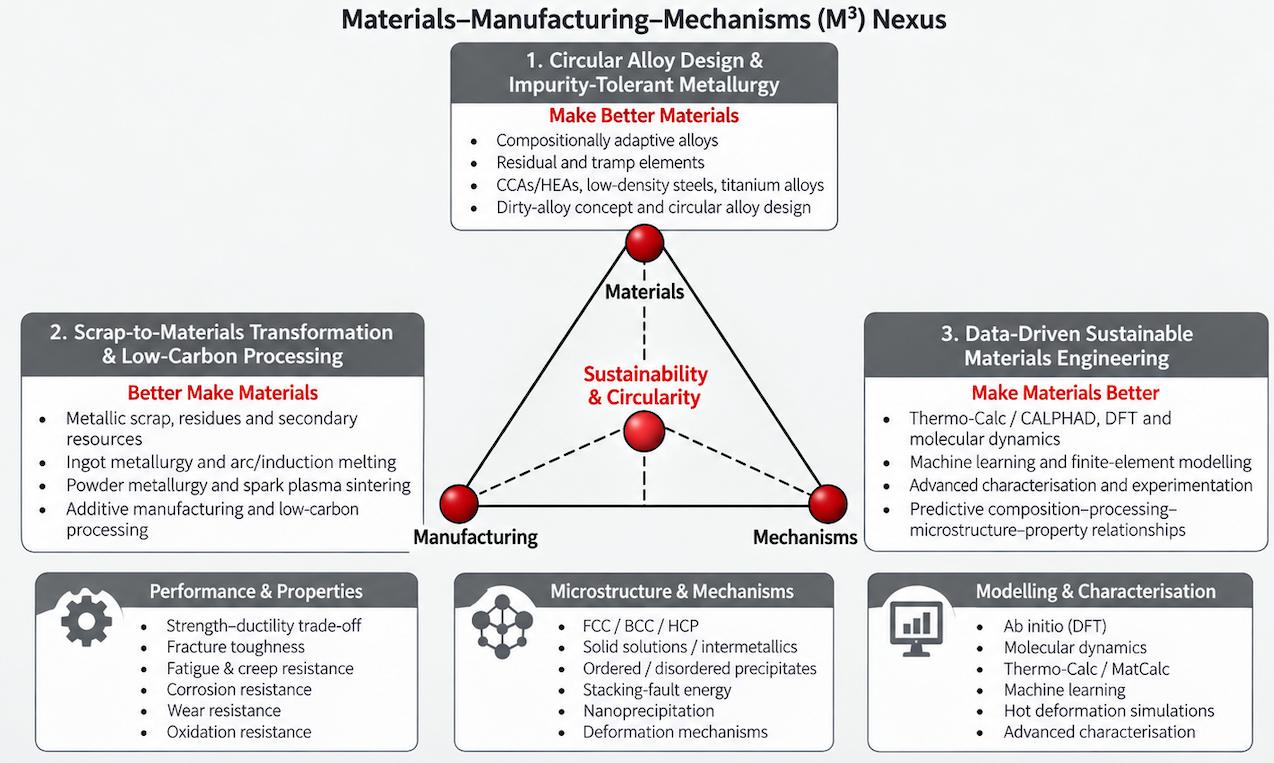
1. Circular Materials Design & Impurity-Tolerant Metallurgy Make Better Materials
Make Better Materials by designing metallic materials around resources, performance and circularity. This thrust develops compositionally adaptive and impurity-tolerant alloys—including CCAs/HEAs, steels, aluminium, and titanium alloys that accommodate or exploit residual elements from secondary feedstocks. Alloy chemistry, phase constitution and microstructure are engineered for demanding structural, energy, health and multifunctional applications.
2. Scrap-to-Materials Transformation & Low-Carbon Processing Better Make Materials
Better Make Materials by transforming how metallic materials are manufactured. Scrap, residues and secondary resources are converted into high-value materials through melting, thermomechanical processing, powder metallurgy and additive manufacturing. Processing–microstructure relationships are engineered to reduce material, energy and environmental burdens while delivering reliable metals for structural, energy, health and multifunctional applications.
3. Data-Driven Materials Performance & Mechanisms Make Materials Better
Make Material Better by revealing and controlling the mechanisms governing metallic-material performance. Advanced characterisation, CALPHAD, DFT, molecular dynamics, finite-element modelling and machine learning connect composition, processing and microstructure to deformation, fracture, fatigue, creep, corrosion, wear and oxidation, enabling predictive optimisation of materials for structural, energy, health and multifunctional applications.
The Intellectual Philosophy
Make Better Materials (Structural and Functional Materials): Alloy design • Circular alloys • Impurity tolerance • CCAs/HEAs • Steels • Titanium alloys
Better Make Materials (Manufacturing): Scrap-to-materials • Casting • Powder metallurgy • Thermomechanical processing • Additive manufacturing • Low-carbon processing
Make Materials Better (Mechanisms): Microstructure • Phase transformations • Deformation • Fracture • Fatigue • Wear • Corrosion • Oxidation • Durability
Timeline:
Theme:
Showing 86 of 86 scholarly works
Journal Publications
Peer-reviewed original research papers in high-impact physical metallurgy, materials science, and engineering journals.
72 Articles
2026
Works
2026
K.J.N. Toure, A. Compaore, Desmond Klenam*, T.K. Asumadu, J.D. Obayemi, M.A. Sarroney, E.F. Assanvo, N. Rahbar, and W.O. Soboyejo, “A Study of the effect of cashew nut shell epoxy resin and graphene reinforcement on soy flour-based bio-composites,” Results in Materials, vol. 25, 100978, 2026.
D.E.P. Klenam, T.K. Asumadu, M.O. Bodunrin, and W.O. Soboyejo, “Comparative assessment of dilute alloys with complex concentrated alloys — Design principles, processing, mechanisms, properties and sustainability,” Journal of Alloys and Compounds Communications, 2026 (Accepted & in Production).
O.J. Lawal, S.S. Lephuthing, P.A. Olubambi, M.O. Bodunrin, and D.E.P. Klenam, “Corrosion behaviour of low-density steels for biomedical applications: A critical review of composition and microstructural effects,” Next Research, vol. 7, 101459, 2026.
N.O. Hassan, A. Ghais, M.H.M. Ahmed, M. Adam, R. Ahmed, A. Abdelatti, D.E.P. Klenam, M.O. Bodunrin, and A. Koko, “Density Functional Theory Insights into the Structure, Electronic and Mechanical Properties, Thermodynamics, and Diffusion of High-Entropy Alloys for Hydrogen Storage: A Review,” International Journal of Hydrogen Energy, vol. 217, 153928, 2026.
M. Vandadi, F. Ghajari, T.K. Asumadu, D.E.P. Klenam, W.O. Soboyejo, and N. Rahbar, “Dislocation analysis in CrCoNi medium entropy alloy using nanoindentation and molecular dynamics simulations,” Proceedings of the Royal Society A, vol. 482, no. 2333, 20250757, 2026.
N.B. Nelwalani, N.P. Bhembe, Z.A. Cader, M.O. Bodunrin, and D.E.P. Klenam, “Effect of Chromium-to-Carbon Ratio and Carbide Volume Fraction on the Three-body Abrasion Wear and Corrosion Behaviour of High Chromium White Cast Iron,” Progress in Engineering Science, 2026 (Accepted & in Production).
Z.A. Cader, O.S. Bamisaye, D.E.P. Klenam, M.O. Bodunrin, and O. Omole, “Influence of Cr/C ratio on microstructure and corrosion of hypoeutectic HCCIs,” Corrosion Engineering, Science and Technology, 2026 (Accepted & in Production).
N.K. Ankah, Z.M. Gasem, T.K. Asumadu, M.O. Bodunrin, D.E.P. Klenam, and W.O. Soboyejo, “Investigation of Vanadium-Induced Hot Corrosion of 8YSZ and MgO-8YSZ composite powder for thermal barrier coatings application,” Materials Today Communications, vol. 51, 114802, 2026.
B.N. Abraham, E. Twumasi, Desmond Edem Primus Klenam*, T.K. Asumadu, A. Bello, V.C. Anye, N.A. Burnham, R. Neamtu, and W.O. Soboyejo, “Machine Learning-Guided Design of Doped Lithium Lanthanum Zirconium Oxide (LLZO) for Improved Performance,” Energy Storage, 2026 (Accepted & in Production).
J.D. Aziafor, B. Ramatsoma, N.O. Hassan, A. Koko, M.O. Bodunrin, and Desmond Klenam*, “Magnesium-Based Hydrides and Complex Concentrated Alloys: A Review of Advancements and Pathways for Next-Generation Hydrogen Storage Materials,” Review of Materials Research, 2026 (In Press).
N. Nkosi, D. Essa, A. Moalodi, J. Lawal, Y. Choonara, D.E.P. Klenam*, and M.O. Bodunrin, “On the Cytotoxicity Assessment and Indentation Size Effect of Low-Cost Experimental Implant Alloys,” ACS Materials Au, 2026 (Accepted & in Production).
D. Mosoma, D.E.P. Klenam, M.A. Okoro, S.R. Oke, and M.O. Bodunrin, “On the spark plasma sintering of Mo- and Cu-containing low-density stainless steel: Influence of sintering parameters on microstructure, densification and hardness considerations,” International Journal of Advanced Manufacturing Technology, 2026. DOI: 10.1007/s00170-026-17793-4.
D. Mosoma, V. Munyangane, R. Sule, D.E.P. Klenam*, M.A. Okoro, and M.O. Bodunrin, “Spark plasma sintering of low-density stainless steel: Optimization of sintering parameters,” Advances in Materials Science and Engineering, 2026 (Accepted & in Production).
H.K. Weefar, T.K. Asumadu, D.E.P. Klenam, F.K.E. Kra, D.M. Abro, and W.O. Soboyejo, “Strain Gradient Plasticity Phenomenon in Construction Steels: Effects of Heat Treatment on Microstructure and Stress-Strain Behavior,” Journal of Materials Research and Technology, vol. 40, pp. 2789–2804, 2026.
N. Rundora, D.E.P. Klenam, O. Falodun, M. Mathabathe, V. Sibanda, and M.O. Bodunrin, “Tribocorrosion response of Fe-modified titanium alloys in simulated body fluids with varying glucose concentrations,” Journal of Applied Biomaterials & Functional Materials, 2026 (Accepted & in Production).
Desmond Edem Primus Klenam*, N.K. Adomako, S.S. Sohn, and R.K. Nutor, “Unlocking superplasticity in medium- and high-entropy alloys,” Communications Materials, vol. 7, no. 186, 2026.
2025
Works
2025
D.E.P. Klenam, F. McBagonluri, T.K. Asumadu, S.A. Osafo, M.O. Bodunrin, L. Agyepong, E.D. Osei, D. Mornah, and W.O. Soboyejo, “Additive manufacturing: Shaping the future of the manufacturing industry — An overview of trends, challenges and opportunities,” Applications in Engineering Science, 21, 100224, 2025.
Ref: https://doi.org/10.1016/j.apples.2025.100224
T.W. Awotwe, G.K. Mukondeleli, N. Ndou, R.W. Maladzhi, D.E.P. Klenam, S. Junaid, F. Azmat, R. Ghannam, and R. Tarip, “An unsupervised machine learning approach to understand staff perception on project-based learning using CDIO framework in African Engineering Education context: The case of South Africa,” SEFI Journal of Engineering Education, 2025.
Ref: https://doi.org/10.62492/sefijeea.v2i2.33
N. Maphanga, D.E.P. Klenam*, M.O. Bodunrin, R. Diale, and J. Moema, “Application of artificial neural networks in predicting and optimising electroplating parameters: A systematic review,” MATEC Web of Conferences, vol. 417, 03019, 2025.
Ref: https://doi.org/10.1051/matecconf/202541703017
D.E.P. Klenam, “Artificial Intelligence in the Development of Structural and Functional Materials: A Transformative Frontier and Complementary Enabler of the Rational Alloy Design Framework,” Next Research, vol. 3, 101157, 2025.
Ref: https://doi.org/10.1016/j.nexres.2025.101157
I.E. Kalu, S.M. Abolarin, D.E.P. Klenam, E.Y. Ishidi, and K.K. Alaneme, “Comprehensive Review on Fitness-for-Service Assessment of Corroded Pipelines: Focus on Model Validation and Industry Applications,” Journal of Pipeline Science and Engineering, 2025.
Ref: https://doi.org/10.1016/j.jpse.2025.100362
N.K. Ankah, Z.M. Gasem, T.K. Asumadu, M.O. Bodunrin, D.E.P. Klenam*, and W.O. Soboyejo, “Early-stage mechanistic insights into vanadium-induced hot corrosion of yttria-stabilized zirconia thermal barrier coatings,” Progress in Engineering Science, vol. 2, no. 4, 100157, 2025.
Ref: https://doi.org/10.1016/j.pes.2025.100157
M. Vandadi, T. Bond, T.K. Asumadu, D.E.P. Klenam, N. Rahbar, and W.O. Soboyejo, “Effect of nanoscale oxide layers on the cold spray of commercially pure titanium and Ti-6Al-4V powders,” Computational Materials Science, 246, 113454, 2025.
Ref: https://doi.org/10.1016/j.commatsci.2024.113454
J. Adjah, B. Agyei-Tuffour, R.A. Ahmed, Desmond Edem Primus Klenam*, D. Dodoo-Arhin, E. Nyankson, K. Mensah-Darkwa, and W.O. Soboyejo, “Effects of external pressure on all-solid-state batteries: A comprehensive review and analysis,” Energy Storage Materials, vol. 75, 104461, 2025.
Ref: https://doi.org/10.1016/j.ensm.2025.104461
J.O. Obiko, M. Ndeto, J. Mutua, B. Shongwe, N. Malatji, M.O. Bodunrin, and D.E.P. Klenam, “Failure analysis of geothermal API 5L grade B steel pipeline,” Engineering Solid Mechanics, vol. 13, pp. 259–266, 2025.
Ref: http://dx.doi.org/10.5267/j.esm.2025.5.001
A. Compaore, K.J.N. Toure, D.E.P. Klenam, A.S. Merenga, T.K. Asumadu, J.D. Obayemi, N. Rahbar, C.M. Migwi, and W.O. Soboyejo, “Foam concrete with mineral additives: From microstructure to mechanical/physical properties, workability and durability,” Open Ceramics, 23, 100812, 2025.
Ref: https://doi.org/10.1016/j.oceram.2025.100812
J.O. Obiko, M.B. Shongwe, N. Malatji, T. Marazani, M.O. Bodunrin, and D.E.P. Klenam, “Hot Deformation of AISI 4340 Steel from a Dynamic Material Modeling Perspective,” Advances in Materials Science and Engineering, vol. 2025, 6644873, 2025.
Ref: https://doi.org/10.1155/amse/6644873
J.O. Obiko, M.O. Bodunrin, Desmond Klenam*, M.B. Shongwe, and N. Malatji, “Hot workability behaviour of AISI 316 stainless steel: Constitutive analysis, dynamic material modelling, and finite element simulation,” International Journal of Advanced Manufacturing Technology, 139, 2393–2408, 2025.
Ref: https://doi.org/10.1007/s00170-025-16030-8
F. Ghajari, M. Vandadi, T.K. Asumadu, Desmond Klenam*, W.O. Soboyejo, and N. Rahbar, “Investigating Carbon Coating on Ni-Invar and Ti-6Al-4V Surfaces for Low Friction Performance,” Langmuir, vol. 41, no. 32, pp. 21425–21434, 2025.
Ref: https://doi.org/10.1021/acs.langmuir.5c01902
T.K. Asumadu, M. Vandadi, D.E.P. Klenam, K. Adinkra-Appiah, K. Mensah-Darkwa, E. Gikunoo, S. Kwofie, N. Rahbar, and W.O. Soboyejo, “Macroscopic superlubricity enabled by graphene nanocomposite film on carbon-coated AISI 1045 steel,” Materials & Design, 251, 113916, 2025.
Ref: https://doi.org/10.1016/j.matdes.2025.113916
L. Mampuru, D.E.P. Klenam*, M.O. Bodunrin, J. Moema, and M. Phasha, “Manganese effect on room and cryogenic temperature impact toughness of thermomechanically processed Fe-Mn binary alloys and commercial 9 wt% Nickel alloy,” MATEC Web of Conferences, vol. 417, 03017, 2025.
Ref: https://doi.org/10.1051/matecconf/202541707009
D.E.P. Klenam, L.H. Chown, M.J. Papo, and L.A. Cornish, “Mechanical behaviour of microalloyed steels with vanadium for rail axles,” Hybrid Advances, 8, 100387, 2025.
Ref: https://doi.org/10.1016/j.hybadv.2025.100387
A. Compaore, K.J.N. Toure, Desmond Edem Primus Klenam*, T.K. Asumadu, J.D. Obayemi, N. Rahbar, C.M. Migwi, A.S. Merenga, and W.O. Soboyejo, “Performance of Foam Concrete Containing Relatively Low Temperature Calcined Clay as Partial Replacement of Portland Cement,” Journal of Materials Research and Technology, vol. 38, pp. 1761–1781, 2025.
Ref: https://doi.org/10.1016/j.jmrt.2025.07.137
B.S. Ramatsoma, M.E. Makhatha, D.E.P. Klenam*, and M.O. Bodunrin, “Role of compositionally complex and high entropy alloys for hydrogen storage: A bibliometric and mechanistic assessment,” Renewable and Sustainable Energy Reviews, vol. 222, 115903, 2025.
Ref: https://doi.org/10.1016/j.rser.2025.115903
O.S. Bamisaye, N. Maledi, D.E.P. Klenam, and M.O. Bodunrin, “Short-term oxidation behaviour of TiNbTaVW RHEA at 850 °C and 1050 °C,” International Journal of Refractory Metals and Hard Materials, 130, 107185, 2025.
Ref: https://doi.org/10.1016/j.ijrmhm.2025.107185
D.E.P. Klenam, O.S. Bamisaye, T.K. Asumadu, M.O. Bodunrin, and W.O. Soboyejo, “Solving the strength-ductility trade-off using complex concentrated alloy design strategy: An overview,” Smart Materials in Manufacturing, vol. 3, 100091, 2025.
Ref: https://doi.org/10.1016/j.smmf.2025.100091
P. Seema, D.E.P. Klenam*, M.O. Bodunrin, C. Hattingh, J. Moema, and M. Phasha, “Investigation of wear and oxidation resistance of laser-clad Fe-Cr-C and composite coatings,” MATEC Web of Conferences, vol. 417, 03018, 2025.
Ref: https://doi.org/10.1051/matecconf/202541703010
K.J.N. Toure, A. Compaore, Desmond Klenam*, T.K. Asumadu, J.D. Obayemi, M.A. Sarroney, E.F. Assanvo, N. Rahbar, and W.O. Soboyejo, “Thermal and mechanical properties of sustainable rigid polyurethane foam composites reinforced with coffee husk fillers,” Polymer Testing, vol. 153, 109028, 2025.
Ref: https://doi.org/10.1016/j.polymertesting.2025.109028
D.E.P. Klenam, T.K. Asumadu, M.O. Bodunrin, J. Obiko, R.M. Genga, S. Maape, F. McBagonluri, and W.O. Soboyejo, “Towards sustainable industrialisation in Africa: The potential of additive manufacturing — An overview,” Frontiers in Manufacturing Technology, 4, 1410653, 2025.
Ref: https://doi.org/10.3389/fmtec.2024.1410653
S.A. Osafo, T.K. Asumadu, D.E.P. Klenam, P. Etinosa, J.D. Obayemi, B. Agyei-Tuffour, A. Yaya, D. Dodoo-Arhin, and W.O. Soboyejo, “Tribological Properties of Hydroxyapatite-Coated Nanorods on Ti-6Al-4V Surfaces,” Scientific Reports, vol. 15, no. 1, 19113, 2025.
Ref: https://doi.org/10.1038/s41598-025-03253-8
2024
Works
2024
S. Maube, J.O. Obiko, J. van der Merwe, F. Mwema, D.E.P. Klenam, and M.O. Bodunrin, “Constitutive analysis of hot metal flow behaviour of virgin and rejuvenated heat treatment creep exhausted power plant X20 steel,” International Journal of Advanced Manufacturing Technology, vol. 132, pp. 1843–1853, 2024.
Ref: https://doi.org/10.1007/s00170-024-13443-9
D.E.P. Klenam, F. McBagonluri, O.S. Bamisaye, T.K. Asumadu, N.K. Ankah, M.O. Bodunrin, A. Andrews, and W.O. Soboyejo, “Corrosion-resistant materials in high-pressure high-temperature oil wells: Potential application of complex concentrated alloys,” Engineering Failure Analysis, vol. 163, 108502, 2024.
Ref: https://doi.org/10.1016/j.engfailanal.2023.107920
N. Rundora, D.E.P. Klenam, S. Polat, J.W. van der Merwe, and M.O. Bodunrin, “Dry sliding wear behavior of experimental low-cost titanium alloys,” Tribology Transactions, vol. 67, no. 3, pp. 560–572, 2024.
Ref: https://doi.org/10.1080/10402004.2024.2357288
J.O. Obiko, B. Shongwe, N. Malatji, M.O. Bodunrin, and D.E.P. Klenam, “Effect of aspect ratio on the metal flow behaviour during forming process: A numerical simulation approach,” Scientific African, vol. 25, e02265, 2024.
Ref: https://doi.org/10.1016/j.sciaf.2024.e02265
O.S. Bamisaye, N. Maledi, J. van der Merwe, D.E.P. Klenam, and M.O. Bodunrin, “Flow behavior and microstructure of hot-worked TiNbTaVW refractory high-entropy alloy,” Advanced Engineering Materials, 2024.
Ref: https://doi.org/10.1002/adem.202400538
B.N. Nelwalani, J. van der Merwe, V. Munyangane, Z.A. Cader, Thato Rampaku, and D.E.P. Klenam, “Hydroxyapatite nanopillars on Ti-6Al-4V: Enhancement in cell spreading and proliferation during cell/tissue integration,” Manufacturing Review, vol. 11, no. 9, pp. 1–12, 2024.
Ref: https://doi.org/10.1002/jbm.a.37726
T.K. Asumadu, M. Vandadi, D.E.P. Klenam, K. Mensah-Darkwa, E. Gikunoo, S. Kwofie, N. Rahbar, and W.O. Soboyejo, “Robust macroscale superlubricity on carbon-coated metallic surfaces,” Applied Materials Today, vol. 37, 102140, 2024.
Ref: https://doi.org/10.1016/j.apmt.2024.102140
D.E.P. Klenam, L.H. Chown, M.J. Papo, and L.A. Cornish, “Steels for rail axle applications: An overview,” Critical Reviews in Solid State and Materials Sciences, vol. 49, no. 3, pp. 163–193, 2024.
Ref: https://doi.org/10.1080/10408436.2022.2137462
B. Addai, K.O. Gyimah, T.K. Asumadu, M. Anto, D.E.P. Klenam, N. Rahbar, and W.O. Soboyejo, “Strain gradient plasticity in AISI A36 plain carbon steel weldment: Comparison of butt and lap joint configuration,” Results in Engineering, vol. 22, 102078, 2024.
Ref: https://doi.org/10.1016/j.rineng.2024.102078
2023
Works
2023
O.S. Bamisaye, N. Maledi, J. van der Merwe, D.E.P. Klenam, M.O. Bodunrin, and A.D. Akinwekomi, “A comprehensive review on the deformation behaviour of refractory high-entropy alloys at elevated temperatures,” Manufacturing Review, vol. 10, no. 12, pp. 1–22, 2023.
Ref: Klenam-2023-018
D.E.P. Klenam, T.K. Asumadu, M.O. Bodunrin, M. Vandadi, T. Bond, J. van der Merwe, N. Rahbar, and W.O. Soboyejo, “Cold spray coatings of complex concentrated alloys: Critical assessment of milestones, challenges, and opportunities,” Coatings, vol. 13, no. 3, 538, 2023.
S. Maube, J.O. Obiko, J. van der Merwe, F. Mwema, D.E.P. Klenam, and M.O. Bodunrin, “Comparative study on hot metal flow behaviour of virgin and rejuvenated heat treatment creep-exhausted P91 steel,” Applied Sciences, vol. 13, no. 7, 4449, 2023.
D.E.P. Klenam, M. Vandadi, T.K. Asumadu, N. Rahbar, and W.O. Soboyejo, “Data science and materials informatics in physical metallurgy and materials science: An overview of milestones and limitations,” Results in Materials, vol. 20, 100483, 2023.
T. Komane, N. Maledi, D.E.P. Klenam, J.W. van der Merwe, and M.O. Bodunrin, “Flow Behavior and Microstructure of Hot-Worked Fe-30.9Mn-4.9Al-4.5Cr-0.4C and Fe-21.3Mn-7.6Al-4.3Cr-1C Low-Density Stainless Steels,” Applied Sciences, vol. 13, no. 4, 2310, 2023.
Ref: Klenam-2023-012
D. Mosoma, D.E.P. Klenam, T. Maunganidze, and M.O. Bodunrin, “Hot working behaviour of low-cost Ti-3.4Fe bio-implant alloy,” International Journal of Advanced Manufacturing Technology, pp. 1–12, 2023.
Ref: Klenam-2023-015
D.E.P. Klenam and Oxford Micromechanics Group, “In-Situ Micromechanical Investigation of Slip System Activation in Titanium and Lightweight Structural Alloys,” Acta Materialia, vol. 254, 118940, 2023. DOI: 10.1016/j.actamat.2023.118940.
M.O. Bodunrin, J.O. Obiko, and D.E.P. Klenam, “On the uniaxial compression testing of metallic alloys at high strain rates: An assessment of DEFORM-3D simulation,” Applied Sciences, vol. 13, no. 4, 2686, 2023.
Ref: Klenam-2023-014
D.E.P. Klenam, M. Vandadi, T.K. Asumadu, N. Rahbar, and W.O. Soboyejo, “Rational Alloy Design Strategies in Complex Concentrated Alloys (CCAs) for Extreme Thermal and Mechanical Environments,” Materials & Design, vol. 232, 112150, 2023.
T.K. Asumadu, K. Mensah-Darkwa, E. Gikunoo, D.E.P. Klenam, M. Vandadi, N. Rahbar, S. Kwofie, and W.O. Soboyejo, “Strain gradient plasticity phenomenon in surface-treated plain carbon steel,” Materials Science and Engineering: A, vol. 871, 144806, 2023.
Ref: Klenam-2023-013
2022
Works
2022
M. Leshetla, D.E.P. Klenam, J. van der Merwe, H. Potgieter, D. Whitefield, and M.O. Bodunrin, “Corrosion resistance of iron-containing titanium alloys exposed to simulated body fluids,” Materials and Corrosion, vol. 73, pp. 1298–1307, 2022.
J.W. van der Merwe, M. du Toit, D.E.P. Klenam, and M.O. Bodunrin, “Fracture mechanics of carbon steel under different carbon monoxide and dioxide gas mixture conditions in water,” Scientific African, vol. 17, e01355, 2022.
D.E.P. Klenam, O.S. Bamisaye, I.E. Williams, J.W. van der Merwe, and M.O. Bodunrin, “Global perspective and African outlook on additive manufacturing research: An overview,” Manufacturing Review, vol. 9, no. 35, pp. 1–37, 2022.
Ref: Klenam-2022-010
J.W. van der Merwe, M. du Toit, D.E.P. Klenam, and M.O. Bodunrin, “Prediction of stress-corrosion cracking using electrochemical noise measurements: A case study of carbon steels exposed to water-carbon monoxide-carbon dioxide environment,” Engineering Failure Analysis, vol. 144, 106948, 2022.
O. Akinbami, L.M. Mohlala, D.E.P. Klenam, J. van der Merwe, and M.O. Bodunrin, “The status of high-entropy alloy studies in Africa: An overview,” Key Engineering Materials, vol. 918, pp. 41–53, 2022.
2021
Works
2021
D.E.P. Klenam, M.O. Bodunrin, S. Akromah, E. Gikunoo, A. Andrews, and F. McBagonluri, “Ferrous materials degradation: A case study of carbon steels exposed to water-carbon monoxide-carbon dioxide environment — Characterisation of rust by colour: An overview,” Corrosion Reviews, vol. 39, no. 4, pp. 297–311, 2021.
Ref: https://doi.org/10.1515/corrrev-2021-0005
D.E.P. Klenam, G.S. Ogunwande, T. Omotosho, B. Ozah, N.B. Maledi, S.I. Hango, A.A. Fabuyide, L. Mohlala, J.W. van der Merwe, and M.O. Bodunrin, “Welding of magnesium and its alloys: A comparison of butt and lap joint configuration and structural integrity of the welds — An overview of methods, process parameters and effects on mechanical behaviour,” Manufacturing Review, vol. 8, no. 28, pp. 1–31, 2021.
Ref: https://doi.org/10.1051/mfreview/2021028
2015–2020
Works
2015–2020
D.E.P. Klenam, L.H. Chown, M.J. Papo, and L.A. Cornish, “Corrosion and mechanical behaviour of typical railway axle steel in water,” African Corrosion Journal, vol. 2, no. 1, pp. 1–10, 2016.
M.O. Bodunrin, L.H. Chown, J. van der Merwe, K. Alaneme, C. Oganbule, D.E.P. Klenam*, and N. Mphasha, “Corrosion behaviour of titanium alloys in acidic and saline media: Role of alloy design, passivation integrity, and electrolyte modification,” Corrosion Reviews, vol. 38, no. 1, pp. 25–48, 2020.
Ref: https://doi.org/10.1515/corrrev-2019-0029
D.E.P. Klenam, C. Polese, L.H. Chown, S. Kwofie, and L.A. Cornish, “Mechanical behaviour of pack carburized AISI 316L austenitic stainless steel,” Journal of the Southern African Institute of Mining and Metallurgy, vol. 115, pp. 1183–1191, 2015.
Ref: https://doi.org/10.17159/2411-9717/2015/v115n12a6
D.E.P. Klenam, L.H. Chown, M.J. Papo, and L.A. Cornish, “Phase proportions, carbon equivalent, mechanical properties and their effect on material cost of railway axle steels,” MRS Advances, vol. 3, no. 37, pp. 2169–2181, 2018.
Ref: https://doi.org/10.1557/adv.2018.348
Book Chapters & Reference Volumes
Invited peer-reviewed chapters and treatises spanning corrosion science, advanced powder metallurgy, and engineering failure analysis.
15 Chapters
D.E.P. Klenam, F. McBagonluri, and W.O. Soboyejo, “Chapter 00165: Mechanical Properties — Fatigue,” In: Encyclopedia of Condensed Matter Physics, 2nd Edition, Vol. 3, Elsevier, pp. 818–837, 2024.
Ref: Klenam-Chapter-011
D.E.P. Klenam and W.O. Soboyejo, “Chapter 00406: Fatigue of Biomaterials and Biomedical Systems,” In: Comprehensive Structural Integrity, 2nd Edition, Vol. 4, Elsevier, pp. 331–359, 2023.
Ref: Klenam-Chapter-008
D.E.P. Klenam, J.E. Oghenevweta, and W.O. Soboyejo, “Chapter 00411: Fatigue of Micro-Electro-Mechanical Systems (MEMS) Thin Films,” In: Comprehensive Structural Integrity, 2nd Edition, Vol. 4, Elsevier, pp. 286–310, 2023.
Ref: Klenam-Chapter-006
D.E.P. Klenam and W.O. Soboyejo, “Chapter 00412: Fatigue of Thermo-Structural Alloys,” In: Comprehensive Structural Integrity, 2nd Edition, Vol. 4, Elsevier, pp. 116–145, 2023.
Ref: Klenam-Chapter-010
D.E.P. Klenam, J.E. Oghenevweta, and W.O. Soboyejo, “Chapter 00710: Fracture and Toughening of Intermetallics,” In: Comprehensive Structural Integrity, 2nd Edition, Vol. 7, Elsevier, pp. 102–139, 2023.
Ref: Klenam-Chapter-009
D.E.P. Klenam, J.E. Oghenevweta, and W.O. Soboyejo, “Chapter 00711: Fatigue of Single/Multiple Semi-Elliptical Cracks,” In: Comprehensive Structural Integrity, 2nd Edition, Vol. 7, Elsevier, pp. 53–72, 2023.
Ref: Klenam-Chapter-007
D.E.P. Klenam, N. Rahbar, and W.O. Soboyejo, “Chapter 01005: Mechanical Properties of Complex Concentrated Alloys: Implications for Structural Integrity,” In: Comprehensive Structural Integrity, 2nd Edition, Vol. 10, Elsevier, pp. 209–239, 2023.
Ref: Klenam-Chapter-004
M. Vandadi, D.E.P. Klenam, N. Rahbar, and W.O. Soboyejo, “Chapter 01008: Advances in the Structural Integrity of Cold Sprayed Metal Alloys — A Critical Review of Process Models and Mechanical Properties,” In: Comprehensive Structural Integrity, 2nd Edition, Vol. 10, Elsevier, pp. 2–37, 2023.
Ref: Klenam-Chapter-001
D.E.P. Klenam, N. Rahbar, and W.O. Soboyejo, “Chapter 01013: Critical Review of Factors Hindering Scalability of Complex Concentrated Alloys,” In: Comprehensive Structural Integrity, 2nd Edition, Vol. 10, Elsevier, pp. 103–121, 2023.
Ref: Klenam-Chapter-002
D.E.P. Klenam, N. Rahbar, and W.O. Soboyejo, “Chapter 01017: Critical Review of Limitations of Equiatomic Composition Alloying Strategy of Complex Concentrated Alloys,” In: Comprehensive Structural Integrity, 2nd Edition, Vol. 10, Elsevier, pp. 122–135, 2023.
Ref: Klenam-Chapter-005
D.E.P. Klenam, G. Egowan, M.O. Bodunrin, J.W. van der Merwe, N. Rahbar, and W.O. Soboyejo, “Chapter 01018: Complex Concentrated Alloys: A Cornucopia of Possible Structural and Functional Applications,” In: Comprehensive Structural Integrity, 2nd Edition, Vol. 10, Elsevier, pp. 50–90, 2023.
Ref: Klenam-Chapter-003
D.E.P. Klenam*, K.D. Ukabhai, and L.A. Cornish, “Co-Ni-Si Ternary Phase Diagram Evaluation,” In: MSI Eureka, MSI Materials Science International Services GmbH, Stuttgart (Accepted & in Production).
B. Agyei-Tuffour, J.T. Asante, L.A. Cornish, D.E.P. Klenam*, and J.B. Haywood-Dadzie, “Co-Ni-V Ternary Phase Diagram Evaluation,” In: MSI Eureka, MSI Materials Science International Services GmbH, Stuttgart.
Ref: Klenam-Chapter-013
A. Watson, D. de Abreu, L.A. Cornish, and D.E.P. Klenam*, “Mo-Ti-Zr Ternary Phase Diagram Evaluation,” In: MSI Eureka (A. Watson, Ed.), Materials Science International Services GmbH, Stuttgart, vol. 98, 2023. DOI: 10.7121/msi-eureka-10.18033.2.8.
Ref: Klenam-Chapter-012
D.E.P. Klenam, “Section V: Sustainable Hybrid and Metamorphic Manufacturing Systems — Trends & Perspectives,” In: Hybrid Manufacturing Processes: From Micromachining to Additive Manufacturing (K. Gupta, Ed.), De Gruyter, 2024.
No publications matched your search criteria.
Funded Research Grants & Active Projects
Chronological dossier of sponsored research grants, bilateral international programs, and industry initiatives from the European Union, NRF, Mintek, CSIR, SUNY Poly, and MIT.
28 Major Grants
PI & Co-PI
BUCABUMA: Building Capacity in Circular Natural Building Materials
European Union (EU NDICI-MOBAF) • European Union Mobility Grant Agreement
EUR €1,430,820
2026 — 2030
Co-Principal Investigator (Co-PI)
Intra-Africa Academic Mobility Scheme, European Education and Culture Executive Agency. Focuses on circular natural building materials using frugal digital and traditional engineering innovation, training researchers across multinational African mobility hubs.
NRF Thuthuka Rating Track Grant (TTK250318304827)
National Research Foundation (NRF), South Africa
ZAR 900,000 (~US $56,000)
2026 — 2028
Principal Investigator
Investigating deformation micromechanics, dislocation pileups, and strain gradient plasticity of high-entropy lightweight steels under dynamic loading conditions.
National Research Foundation 'Y' Rated University Support Funding
University Research Committee (URC), Wits University
ZAR 100,000 (~US $6,200)
2025 — 2030
Lead Recipient
Institutional incentive funding in direct recognition of national peer-evaluated Y-Rating as a promising young researcher in physical metallurgy.
National Research Funding Y-Rating Grant (RA231031159798)
National Research Foundation (NRF), South Africa
ZAR 50,000 (~US $3,100)
2025 — 2029
Principal Investigator
Competitive national incentive grant for emerging scholars establishing independent laboratory infrastructure and doctoral training pipelines.
Physical Metallurgy & Alloy Solidification Industry Grant
FerroMet Foundries & Mintek Industrial Consortium
US $48,000
2025 — 2027
Co-Principal Investigator
Optimizing inoculation fade kinetics and cooling curve thermal analysis for high-volume grey and ductile iron castings in automotive applications.
Revamping Indigenous South African Foundries
Council for Scientific & Industrial Research (CSIR) / NFTN
ZAR 600,000 (~US $38,000)
2025 — 2027
Project Lead (Wits)
Alloy reformulation and scrap tolerance optimization to assist local SMME foundries transitioning to circular charge materials and lower emissions.
Crucible Funding: Spark Plasma Sintered Cardiovascular Implants
Wits–Leeds Global Crucible Programme
GBP £8,000 (~ZAR 190,000)
Jan — Dec 2026
Co-Investigator (with Univ of Leeds)
Bilateral grant designing biocompatible spark plasma sintered titanium-molybdenum composites for next-generation vascular stents and biomedical implants.
Establishment of the Global Centre for Advanced Materials & Manufacturing (GCAMM)
SUNY Polytechnic Institute & International Consortium
US $280,000
2024 — 2026
Senior Fellow & Board Member
Multi-institution initiative establishing cold spray additive manufacturing and materials informatics capabilities between North America and African institutions.
Titanium Alloys & Nanostructures for Next-Generation Biomedical Devices
Wits Research Incentive (URC) & Faculty Strategic Fund
US $52,000
2024 — 2026
Principal Investigator
Electrochemical tribocorrosion and in-vitro cellular biocompatibility of novel low-modulus titanium alloys in simulated human physiological environments.
Irradiation Stability of Indigenous Carbonitriding Agents
Nuclear Energy Corporation of South Africa (NECSA) & Wits
US $22,000
2024 — 2026
Principal Investigator
Evaluating radiation-induced phase transformations and passive film durability in surface-hardened nuclear-grade stainless steels.
Top Slice Early Career Grant: Complex Concentrated Alloy Tribology
Faculty of Engineering & Built Environment, Wits
ZAR 50,000 (~US $2,500)
2023
Principal Investigator
High-temperature dry sliding wear testing and oxide glaze formation mechanisms in refractory high-entropy alloys.
Worcester Polytechnic Global Fellowship Award: Macroscale Superlubricity
Worcester Polytechnic Institute (WPI), USA
US $10,000
2023
Co-Investigator
Investigating graphene-assisted macroscale superlubricity and environmental barrier mechanisms on structural engineering substrates.
Top Slice Early Career Grant: Low-Density Austenitic Steels
Faculty of Engineering & Built Environment, Wits
ZAR 40,000 (~US $2,000)
2022
Principal Investigator
Spark plasma sintering kinetics and Mott-Schottky semiconductor properties of passive films on lightweight Fe-Al-Mn-C steels.
Worcester Polytechnic Global Fellowship Award: Low-Cost CCA Design
Worcester Polytechnic Institute (WPI), USA
US $5,000
2021
Fellow
Thermodynamic screening and experimental synthesis of low-cost complex concentrated alloys for energy transition applications.